The Old Connecticut Garden

The Old Connecticut Garden
The Owl and the Orchard

Sunday, August 7, 2011

Going Native

Going Native

Lady Slipper in bloom in Maine.
Crossing the bridge into Maine at dusk last Friday, as the mist inevitably closed in, it was possible to discern that spring has only just arrived in southern Maine.  Saturday morning when the daylight penetrated the fog shrouding Pemaquid Point I could see that the daffodils have yet to “peak” and the lady slippers have yet to bloom.  Lupines are still a month away. 

Admiring the spring flowers in the country gardens along the way to the Cupboard CafĂ© which serves the world’s best breakfast sandwiches and the world’s most fantastic sticky buns (http://www.thecupboardcafe.com/ ) I was reminded of the conclusion I draw every spring: Magnolias, Kwanzan cherry trees, and other non-native trees and shrubs look very out of place here, while the natives look quite at home. 

I felt a pang of conscience as I considered this.  I have been writing about so many non-native plants lately that, to justify myself, I tried to believe that the obverse is true back home and that native trees and shrubs don’t look as comfortable in urban gardens as they do in the country.  That, however, is bunk.  In reality, most natives look great in Georgetown. 

Amelachier blooming next to the Potomac.

Take, for example, amelanchier canadensis, a native from Maine through the Carolinas.  It is now at its peak Downeast, but in DC it blooms in early April.   Its common names, shadblow or serviceberry, reflect the timing of its blossoms – when the shad runs and when, in the “olden days”, the traveling parson could reach remote towns after the snows had melted and the mud had subsided to perform the services of marriage, baptism, and funeral.   I love its delicate flowers, which appear just before the bronze tinged foliage emerges, as well as its lovely gold and orange autumn color.  In August, birds eat the dark blue berries that their human competitors use in jellies, pies, and pemmican.   Emphasizing the important role native plants play in our ecosystem, amelanchiers are a larval food for the red-spotted purple butterfly, which strangely enough, is actually black and blue!   These are great specimen trees and there are several cultivars from which to choose.

A native dogwood in full bloom.


Another excellent tree that is a larval food source for butterflies (this time the sweet blue “spring azure butterfly”) is our own native dogwood, cornus florida.  I have never subscribed to the belief that native dogwoods are too susceptible to disease to be reliable – that claim seems a ploy to sell hybrids and Korean dogwoods.  Native dogwoods just need to be planted well in moist, rich soil.   Ranging from light to dark pink and creamy white, dogwoods are the perfect small-garden tree not only for its spring glory but for its voluptuous red berries in fall which are devoured by birds, its purplish red fall color, and its dark craggy bark which looks dramatic against a frost-tinged backdrop.  Amazingly, what we think of as petals are really colored leaves called “bracts” that attract pollinating insects like bees to the tiny yellow flowers at their centers.    I love knowing that this American tree was introduced to England in the second decade of the 1700’s.

The pea-shaped flowers of the native redbud.
Blooming in late April coincidentally with dogwoods is the redbud, (cercis canadensis), a tree purported to be a favorite of George Washington’s, who had them planted in abundance at Mount Vernon.   If you have never seen dogwoods and redbuds blooming simultaneously along the Skyline drive, make your plans for next spring now.  It is breathtaking.  Redbuds are in the pea family and their little pea-like flowers cling to dark branches before the emergence of leaves.  The flowers, ranging from lavender to purple to white depending on the cultivar, are purportedly edible if you like that sort of thing (edible flowers make me squeamish) and are an important nectar source for honey bees while cardinals are among the birds that dine on the seeds.  As I toy with the notion of planting a non-native Japanese maple for its dark  red foliage, I quickly remind myself that one of my favorite redbud cultivars is “Forest Pansy”.  Its leaves are a dark purple-ish red and look stunning all summer long if planted in a good deal of sun -- like Japanese maples, the leaves become greener in shade. 

Halesia blooming the woods beside the C&O Canal.
Silverbells or snowbells (halisia) are little-known trees that bloom just about the same time as amelanchiers.  They are uncommon, perhaps because they are a bit fussy if not planted in part shade and in moist but well-drained acidic soil.  They have delicate white flowers, though there are pink-flowering cultivars, which hang pendulously from their branches just as the spring-green foliage emerges.  True, the leaves are not very colorful in fall, but the nectar of its beautiful flowers is very important to bees – did you now there are over 700 native species of bees?  Interestingly enough, halisias are named for Dr Stephen Hales (1677-1761), the first man to measure blood pressure in horses and sap pressure in trees.

Fringe Tree's flowers are as fragrant as they
are beautiful.
And then there is the amazing fringe tree (chionanthus virginicus), which has just finished blooming in Georgetown.  This fragrant American native is in the olive family and was used medicinally for a number of ailments ranging from jaundice to dyspepsia.  It is a relatively slow growing tree or shrub that leafs out late and has a subtle golden fall color.  Like gingko trees and hollies, fringe trees are dioecious (yes, this will be on the exam) which means they are either female or male.  While the males tend to have the showier flowers only the females bear the bluish olive-shaped drupes beloved by birds.  It is often impossible to know what gender the bushes are when purchased, but if it has drupes, you know it’s a girl.  It was surely the fringe tree’s delicate beauty and fragrance that compelled Thomas Jefferson to ask a botanist friend in Philadelphia to send him chionanthus seeds while he was living in Paris in 1786, so he could grow them there.  They are notoriously slow growing, though, so it probably took his seedlings years to bloom.

So what is the big deal about native plants?  Aside from their beauty, they provide food and shelter for birds, butterflies, and our dwindling populations of bees.  They tend to require less watering, fertilizer, and pest control because they are already adapted to our environment, and if they self-sow they are not considered detrimentally invasive like English ivy, Norway maples, and barberry are.   I am no purist but there is a lot of sense in using what naturally occurs in our area, especially when it comes to the role native plants play in supporting wildlife.   There are many sources of information about using and procuring natives, from books to magazines, and a variety of websites.  A great place to start is a Washington State-based website ( http://www.plantnative.org/ ), which has information by state and region on plants and nurseries.  Go native!

Tuesday, May 24, 2011

Two posts about Tudor Place events


Tour Georgetown’s Garden Treasures: Tudor Place and Dumbarton Oaks
 this Saturday, May 14, 2011 at 10:30 a.m.


Two of my favorite public gardens are in Georgetown.  How lucky can you get? Better yet:  Both are on tour this Saturday morning!   At 10:30 am Gail Griffin, Director of Gardens & Grounds at Dumbarton Oaks, and Suzanne Bouchard, Director of Gardens & Grounds at Tudor Place will lead a group through both gardens. 
What I love about these two gardens is the contrast between their histories and their designs. Tudor Place, steeped in the history of the Custis Family (Martha Washington’s granddaughter, Martha Custis Peter and her husband, Thomas Peter, purchased it in 1805) and the development of the Capitol, reflects the family’s requirements for food production and beauty as it evolved over six generations.  It is unique in how long the house and gardens were owned and lived in by a single family.  Moreover, no designer was involved in it’s creation yet it stands out as an intimate and beautifully laid out garden with a tremendous plant collection, some of which is related to plants at Mount Vernon.  It’s worth a trip this week, just for its rose garden!
Dumbarton, on the other hand, is the result of a 25-30 year collaboration starting in 1921 between landscape architect Beatrix Farrand (niece of Edith Wharton, and the only female founding member of the American Society of Landscape Architects) and Ambassador and Mrs. Bliss —educated, cultured, and noted art collectors.  Their efforts resulted in the creation of a spectacular terraced garden, a stunning blend of European and American influences.
This tour is a great opportunity to learn how the gardens at Dumbarton Oaks and Tudor Place have evolved aesthetically since the nineteenth century and the challenges surrounding their preservation today.
Reserve now, as space is limited! 
Dumbarton Oaks & Tudor Place Members: $10
Nonmembers: $15
Go to http://tudorplacegardentour.eventbrite.com/ to register.


Herbs Workshop at Tudor Place, Saturday, May 21, 2011

If you love history, eating, cooking, and plants, you will be pleased to know there are still a couple of openings for the first of three “Garden to Table” workshops inspired by the historic gardens at Tudor Place. This first workshop, which will run from 10:30 until 2:30, will focus on container herb gardening with a Mediterranean theme, reflecting the travels of the last owners of Tudor Place. It will be taught by Suzanne Bouchard, Tudor Place Director of Gardens and Grounds, and lifelong "foodie" and owner of Just Simply...Cuisine, Chris Coppola Leibner.  Just Simply...Cuisine is a teaching kitchen in Woodley Park that depends on local grocers, farm markets, butchers, fishmongers, bakeries and dairies to inspire students.  Workshop participants will start the day at Tudor Place where they will learn hands on the basic steps of herb gardening, primarily in containers, and each participant will create their own herb filled container to take home.  Lunch will be provided at Just Simply….Cuisine after the cooking class.  Students will dine on their own culinary creations based on the herbs discussed and planted in the morning session.

Tudor Place is now a relatively formal garden but at one time had vegetable gardens and its owners grew herbs in the flower knot, which is now the renowned rose garden. 

The next two workshops are “Edible Flowering Plants for the Garden” on June 18, and “Fruit Production for Small Spaces” on July 16. At both workshops, Suzanne Bouchard will discuss how the Peter family incorporated each theme (herbs, edible flowers, & fruit trees) into their gardens and examples you can see today.

The workshops are $90 per session or $260 for all three sessions for members, and $95 per session or $275 for all three sessions for non-members. You can register for these workshops (the deadline for the one this Saturday is Friday) online at: http://gardentotable.eventbrite.com/


I wish I had a pick up truck…

As a garden designer, I feel I should comment on the layouts of the various wonderful gardens on last week’s Georgetown Garden Tour, and indeed, I have much to say.  My inner plant nerd, however, has taken my design-training hostage, and instead I am compelled to write about some of the truly beautiful plant combinations on display.  These are plantings you can and should try in your own garden!

Coral Bells and Strawberry "Lipstick"
The sheer imagination of the planting designs on this year’s tour shone.  Take the combination of Coral Bells (Heuchera), a North American native, and ornamental strawberries (Fragaria – probably the cultivar “Lipstick”).  This color combination was show stopping, with sprays of miniature light pink blossoms floating delicately above dark pink strawberry flowers.  The soft green leaves of the coral bells hovered slightly above the small, dark green leaves of the strawberry plants, ensuring a pleasing contrast when both plants have stopped blooming – one that will persist in winter since both plants, which prefer sun and partial shade, are also evergreen. 

My Favorite Heuchera
The ornamental strawberries, which are not grown for their fruit, also looked amazing with a purple leafed heucheraHeucheras have been intensely hybridized over the past several decades and now come with a broad and shocking variety of colored leaves and names that make my mouth water: “Marmalade”, “Plum Pudding”, “Mocha”, “Tiramisu”, “Berrie Smoothie”.   Their leaves range in color from orange to deep purple, silver to mottled everything, and I will confess I find many disconcerting and unappealing beyond their culinary names.  I am a devotee, however, of the deep purple leafed varieties, which look fantastic in the garden.  Here they were planted to great effect with white roses and the strawberry blossoms but I’ve also seen them with Japanese painted ferns, which have silver leaves accented with purple.  This is combination is definitely on the “must plant” list.

An Architectural Success
Allium (Ornamental Onion) is always beautiful and I was pleased to see it planted with another of my favorites, variegated Solomon’s Seal.  I loved the color arrangement of the purple and white blossoms and the white and green stripy leaves, but I’m not sure that I wasn’t more enchanted by the combination of this erect stem topped by its spherical umbels, the arching stems of the Solomon’s Seal, and the broad, soft leaves of two different hostas. The backdrop of a Cherry Laurel’s glossy pointed leaves lent not only a dark green foil for the brighter colors but ensured winter structure.  The entire planting was an architectural success.

Shimmering Lamium and Lime Green Hosta
Hostas are deer lettuce – or perhaps, mesclun – and therefore, I regularly found them munched to stubs in my old Connecticut garden. I was consequently delighted to see lovely hostas planted throughout the tour, and was especially taken by a large, lime green form that was tucked in a bed of lavender-flowered lamium.  Lamium is a wonderful ephemeral ground cover that also comes in a white-flowered variety, and both create a soft variegated carpet in summer.  Here, the small soft rosy purple blossoms were a perfect contrast to the relatively huge lime green hosta leaves, and both were set off by the lamium’s small silver and green leaves which caught the dappled sunlight and made this bed shimmer.

Every garden needs toad lily and hellebores!
There was also a wonderfully healthy planting of stinking hellebores.  The chartreuse flowers of the hellebores emerged in winter and the brightly colored sepals remain, contrasting beautifully with their narrow, bluish green foliage.  They were planted next to toad lilies (tricyrtis), another of my all time favorites.  The contrast of the hellebore and tricyrtis foliage will be beautiful all summer as the toad lily has soft green strappy leaves evenly spaced along its long, arching stems, but the real treat will come at the end of summer when the tricyrtis reveals its little mottled orchid-like flowers.  Every stem bears a series of flowers, individually tucked into the joining of the leaf to the stem.  They are gorgeous moist shade lovers that should be considered mandatory additions to every shade garden.

The Startling Hakone Grass
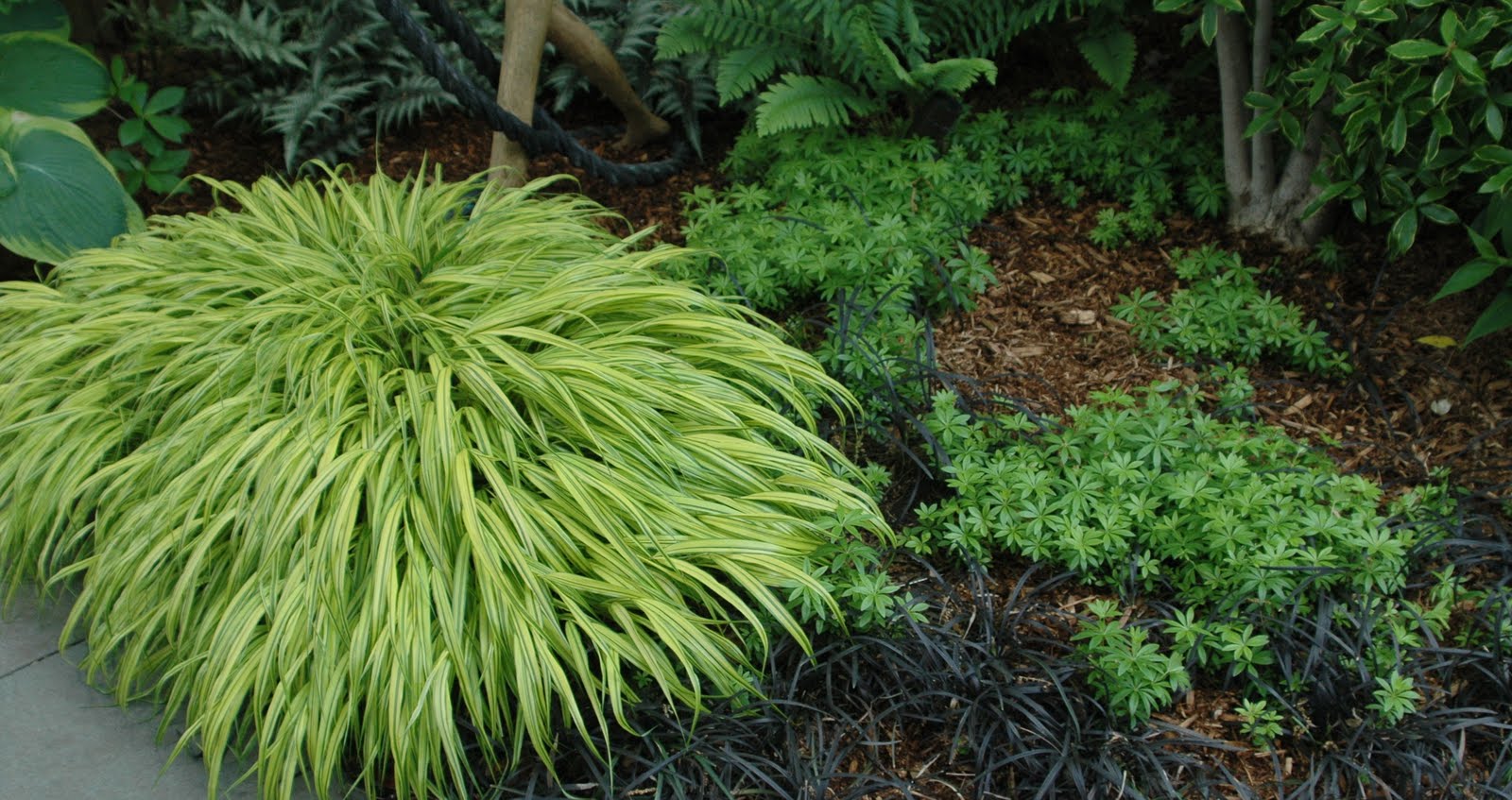
Another real eye catcher for partial shade is Hakone grass (Hakonochloa macra), especially the cultivar “Areola”, which was the Perennial Plant Associations 2009 Perennial Plant of the Year (so there).  It’s yellow and green striped leaves are always startling, sometimes too much so, and I always feel it must be used cautiously.  In this garden, it was perfectly balanced by a diversity of hosta, ferns, sweet woodruff, and black Mondo grass that blended well together to create a coherent planting -- very elegant and imaginative.  Hakone grass likes moist, rich soil and unlike many grasses, does better with some shade, especially in hot climates.  It’s also well behaved as it is a slower grower and doesn’t self-sow.

The Miniature Petticoat Daffodile
Finally, I will single out one little bulb that has charmed me for weeks.  It is visible from the street and I have walked by it several times so it was exciting to see it up close.  It is the petticoat daffodil (Narcissus bulbicodium – and you should know that bulbicodium is Latin for “wooly bulb”).   Most of us think of daffs as relatively large, but there are a whole series of them that are small, perfect for small gardens.  The petticoat daff, which grows to a whopping 8 inches, is the only one I can think of that is at once small and very very loud with a bright deep yellow that you wouldn’t miss with a blindfold on.  They are great in masses or as accents in small gardens, and are supposedly not difficult to grow in pots for springtime forcing. 

I am so inspired by the gardens on the tour that I am now ready to purchase everything on this list and more.  It is times likes these that I lament my decision to drive a Mini Cooper.


Tuesday, May 10, 2011

Garden Tour and Celebrating Georgetown's Trees....


Roses and bluebells and deutzias, oh my!

According to weather.com, this Saturday is supposed to be a lovely 71-degree day – the perfect temperature for touring the nine spectacular gardens on the 83rd annual Georgetown Garden Tour, sponsored by the Georgetown Garden Club.  Pick up your tickets at Garden Tour headquarters at Christ Church, (31st and O Streets, NW), and start walking.  The whole fabulous experience runs from 10AM until 4PM plus you can do a little shopping for beautiful topiaries, fine porcelain vases, and unusual gardening tools at the Garden Boutique (don’t forget Mother’s Day is Sunday)! When you are all tuckered out and want to sit and reflect on the day’s adventures, head over to Keith Hall at Christ Church between 2 PM and 4 PM for tea.  It’s billed as a “not-to-be-missed tea”, and since the cookies, tea sandwiches, and sweets are all homemade by members of the Georgetown Garden Club, I believe them. 

Get your sunscreen and walking shoes out, people!  Come be inspired by the secret gardens of Georgetown!

Tickets are $35 and the tea is included.  The experience is priceless! 
For more information go to http://www.georgetowngardentour.com/index.html


Celebrate Georgetown’s Trees

By now you must have noticed all the new trees that have been planted this spring in the empty tree boxes along our sidewalks.  This fantastic effort has been undertaken by “Trees for Georgetown”, a volunteer committee of the Citizen’s Association of Georgetown, which identifies vacant tree boxes and works to fill them with trees that will ensure our neighborhoods will have green, leafy canopies shading our streets for years to come.  They also do yeoman duty in summer by trying to make sure trees are adequately watered.

If you are like me and value this effort, you should know that “Trees for Georgetown” is having its’ spring fundraiser on Wednesday, May 11 from 6-8 pm at Jill and Rock Tonkel’s historic home.  Herman Hollerith built it at the turn of the 20th century for his three maiden daughters, Lucia, Nan, and Virginia who, with their mother, co- founded the Georgetown Garden Club. For all you history buffs, Mr. Hollerith invented the punch card tabulating machine that was used in the 1890 national census, saving our country $5 million (back when a million bucks was a million bucks).

“There are over 3000 tree boxes in Georgetown”, says Betsy Emes, head of Trees for Georgetown.  “The price of everything has gone up from the fences to the trees.  Two years ago we had big damage due to snow and many trees have had to be removed, so there are more vacant spaces.  We are doing our best to plant as many trees as we have can, so we are raising money to plant more.” 

Each tree, including installation, tree fence, and mulch costs $900.   Be a Patron for $1000, a Sponsor for $500, a Friend for $150, and a Junior, if you are under 35, for $75. There will be a drawing for a free custom protective tree box fence at the party!  Pay at the door or send your donation for the fundraiser to Bob Laycock, Trees for Georgetown, 3258 O Street, N.W., Washington 20007.  General donations can be sent to CAG, 1365 Wisconsin Avenue, N.W., Suite 200, Washington DC, 20007.  For further information, email Betsy Emes at Betsyemes@aol.com.


Not Just a Voyeur…


Not Just a Voyeur…

I have already purchased my ticket for the Georgetown Garden Tour.  It’s not until May 9th, but I can’t wait, so I’ve bought my ticket to ensure that soon I will be walking through Georgetown with a pass that will give me entree to some of its loveliest and most exclusive gardens.  It’s like holding the golden entrance ticket to Willy Wonka’s Chocolate Factory. 

I last went on the Georgetown Garden Tour in the early 1990’s. I moved to Connecticut the following fall, and consequently haven’t been on the Georgetown tour since.  Though I’ve been on many tony tours elsewhere, it remains my favorite. It’s not just that I am a voyeur (actually, I like to think of myself as “one in search of inspiration”).  There is something uniquely singular about having permission to breach garden gates and doorways where access is normally denied, and entering what are essentially separate universes divided from the real world by a mere garden wall or fence. 

Setting up this garden tour is a gargantuan task undertaken by the Georgetown Garden Club that begins with the enlistment of diverse gardens.  This year, as Georgetown Garden Club member Jane Matz assured me, “The contrast in the gardens is small and large, very modern and very traditional, lawns and pools, guest houses and tree houses.  We're thrilled to get every garden, as most visits to Georgetown never let you see the charm and expanse behind the houses”. 
 
Yet it’s not just finding gardens and gaining permission to display them.  Volunteers must be assembled, homeowners reassured, sponsors found, vendors arranged, publicity organized, and other logistics anticipated and thought-through.  Surely prayers are said as well, not only for a beautiful “day of”, but also for a “Goldilocks spring” – neither too hot nor too cold, neither too wet nor too dry.  One of the garden owners told me last week that,  preparing has been easy but a bit frustrating in that the cold winter delayed the production of the flowers”.  Hardly had he uttered his words when, of course, the weather turned unseasonably warm!

This year’s tour features nine superb gardens. Several are formal, but one belongs to an old farmhouse – one of those delightful surprises one discovers in Georgetown.  Several of the gardens are professionally designed including one that is congenial to wheelchairs (you might never notice), a formal garden that is unexpectedly large with gravel paths and a swimming pool, and still another that is, according to designer and long-time tour organizer, Edie Shafer, “snappy and stylish”.

Evermay will be on the tour, but will not be the only garden of historic significance.  After all, this is Georgetown!  One garden boasts a water pump that was used to supply water when the White House was under construction and another was once owned by Abraham Lincoln’s only surviving son.  Its’ boxwoods are said to have been planted by Robert Todd Lincoln himself over 100 years ago, just blocks from where his brother, Willy, was once buried.  Its’ owner confided to me that  what stuns me about the yard is the feeling of quiet and country and we are literally one block from M St. I feel like I am in Middleburg when I sit back there. Also the history is very stirring, with the only remaining cornerstone of 1751 Georgetown.”

As a plant lover, I am dying to know what will be blooming a week from Saturday – tulips, bluebells, roses, wisteria, dogwoods, azaleas, peonies, alium, the catkins of Corylis avellana “Contorta” (but you expected a bit of Latin)?  I find myself trying to anticipate what will be out, what will be gone by, and what not quite there yet.  Since each walled garden is it’s own microclimate determined by site orientation, shade or sun, and other conditions, it will be fascinating to see the variation in plant development from one garden to the next.   I have also heard there are edible plants in some of the gardens.  I’m dying to see how they are arranged.  Then there are the pots, containers, and urns:  Will more exotic summer annuals have replaced pansies?  It’s all too exciting!

And being of an acquisitive as well as an inquisitive nature, I don’t mind confessing that I’m secretly looking forward to having tea at Christ Church’s Keith Hall (between 2-4 pm) and browsing various items at the Garden Boutique.  I am told there will be herbs, small topiary standards from Cultivated Gardens, vases from Middle Kingdom, and various items on consignment from Georgetown merchants for sale.

Fortunately, one can enjoy the entire day, the tea, and all without guilt since the proceeds of this wonderful tour will benefit the preservation of historic parks and public spaces. Tickets are $30 before May 2 and $35 thereafter.  I will see you there!


Tuesday, April 26, 2011

Spring Comes to Dumbarton


When I left my two-acre Connecticut garden for a postage stamp in Georgetown, friends and acquaintances alike asked me in sympathetic tones “how can you leave your garden?”  I smugly rejoined that I was moving to a place where I would “have” several gardens, like the one designed by Beatrix Ferrand at Dumbarton Oaks, where I can meander at will without having to fuss about ground hogs, weeds, pruning, etc.  I imagine it’s a bit like being a grandparent:  You get to enjoy your grandchildren and then hand them back to their parents when they need changing or hit puberty.

With this in mind, to escape the Capitol’s preoccupation with a threatened government shutdown and enticed by an e-mail announcing that the “gift shop is in Bloom” I headed to Dumbarton for a stroll. Arriving in late afternoon, I bought a reasonably priced season pass and found that it is not only the shop that is in bloom.  The gardens are at that glorious mid-spring moment when nearly naked trees and shrubs stand side by side with others heavily endowed with breathtaking blossoms and spring green leaves – quite literally breathtaking, as my allergies suggested.

Dumbarton's ancient katsura
I love Dumbarton not just for its rich panoply of plants, but also for it’s stunning layout.  It has good bones so it is just as beautiful in mid-winter, bereft of leaves and flowers, as it is in peak spring, a test of good garden design.  While it is full of Italian, French, and British influences, and its plants hail from the four corners, I like to think of it as truly American, a melting pot of influences yielding a unique and inspiring result still evident though Farrand’s original design has been altered over time. 

While you can walk straight up to the gardens along the gravel drive from the R Street entrance, I prefer to enter along the shaded, shrub enclosed walk on the south side of the East Lawn to pay homage to the ancient Katsura (cercidiphyllum japonicum) featured there.  The leaves on this Asian native, which turn a gentle yellow-orange in fall, are heart shaped, which is what “cercidiphyllum” refers to, but they are not yet out.  As a result, this specimen’s magnificent structure, from root to twig and stark against the fresh greenness of the spring lawn, is completely captivating.  Whether upright or weeping, Katsuras are hardy in zones 4-8, require consistently moist soil, and are a superb choice for large spaces. 

Yellow epimediums
Dark pink epimediums
Deep in the heart of the gardens, I stumbled into the Prunus Walk where the flowering plums (Prunus x blireana) were peaking.  I know I should have been more excited about these trees, replacements for the original yew hedge, but I was utterly mesmerized by the groundcover beneath them.  There, blooming above a dusting of fallen plum petals is deep pink and pale yellow Bishop’s Mitre (epimediums).  There are over 60 species of epimediums, some of which are purported aphrodesiacs, hence another common name: “Horny Goat Weed”.   They are low growing hardy perennials, mostly from China and central Asia.  Charming enough for their heart shaped leaves and drought tolerance, their delicate blooms are to die for – tiny flowers resembling a miniature cross between daffodils and columbines and ranging in color from yellow to white to lavender and this delicious dark pink.  My epimediums in Connecticut, unmolested by deer and groundhogs, were too far from the house to be enjoyed.  Now I will include them along my front walk where they will revel in part shade and I can easily see them.

Pink crabapple just breaking bud
Crabapple Hill is just starting to peak as well.  It’s worth the hike up from the lower gardens to see these trees breaking bud.  I love crabapples (Malus) because many varieties are nearly as beautiful in fall and winter as they are in spring when they bear beautiful small persistent red, orange, or yellow fruits. The trick when choosing crabapples is to be sure you have one of the fruiting varieties that are disease resistant because, as members of the rose family, they are susceptible to nasty blights that can leave them looking perfectly horrible in mid-summer.

Icy blue Ipheon -- the darker ones
are gorgeous, too
In front of the house I came across one of my favorite bulbs in full stunning bloom.  Spring Starflower (Ipheon uniflorum), from southern South America, is a fantastic shade of icy blue (it also comes in white, dark violet and pink) and is perfectly sited in slightly shady spot beneath a blooming pink and white viburnum.  Its slightly garlicky smell is off-putting to squirrels, which otherwise flagrantly dine on tulip and crocus bulbs, and it naturalizes beautifully.  It needs to be tucked where its fall grass-like leaves are not annoying, just like the Armenian grape hyacinth (muscari armeniacum) that blooms near Dumbarton’s main gate.  Indeed, I recommend planting them together because they are an eye-catching combination.

Swathes of muscari
The guards at the gate are very polite, but I took the hint the third time they asked me if I’d enjoyed the gardens.  It was closing time, so I thanked them for their patience, and reluctantly walked through the graceful gates.   With my season pass snug in my wallet, and Dumbarton’s excellent gardeners on duty, though, I know I can come back any day between 2-6pm, except on Mondays, to enjoy “my garden” again.


Northern Exposure


Northern Exposure
March 28, 2011

Last week, when I thought it was spring, I yanked the straggly hydrangeas and ailing boxwoods from my front walk, leaving a lovely blank space, just begging for new plants.  My front walk is on the north side of the house.  This northern exposure means I’m going to have to find things that will thrive in deep shade.  As I often do when in need of inspiration (or just feeling nosy), I walked around the neighborhood to check out what is “going on” in other north side gardens.  It is admittedly a little early for most perennials, but this didn’t deter me. 

 Spiky Mahonia aquifolium
Determined to hunt down “plants of interest” (sniff), I walked several blocks before being stopped in my tracks by a plant that reminds me of my childhood in Seattle.   Oregon grape, (Mahonia aquifolium -- don’t you love Latin?) has been in bloom for weeks now, displaying clusters of yellow flowers in 2-3 inch racemes (flowers that bloom along a stem).  Mahonia is not for the faint-of-heart because of its off-putting spiky dark green leaves that turn purplish in winter.  I rather like its fierceness, and delight in memories of smearing its dark bluish purple berries on my little brother’s t-shirt as a child.  It is often used as a foundation plant and does best when protected from winter winds because as tough as those leathery leaves look, they are susceptible to desiccation. 

Chaenomeles flouting the cold
Encouraged, I soldiered on along the cold shady sidewalk when I was distracted by a glorious quince (Chaenomeles speciosa), in full bloom across the street.  By this time I was chilled and digressing to photograph this gorgeous Chinese native in full sun was irresistible.  Like many deciduous early bloomers, it begins blooming on bare, spiny twigs before its’ leaves appear.  Quince’s emergent leaves are tinged with a complimentary reddish-bronze color that softens into a dark green in summer but drop in autumn without changing color.  While it blooms best in full sun, I have seen it growing in dry light shade where it still blooms well.  Quince is used as a specimen, as espaliers, in mass plantings where fall and winter interest are unimportant, and mixed in borders where colors ranging from white to pink to salmon colors are wanted.  Its fruits are not remarkable but can be used in preserves, and its salt tolerance makes it an attractive alternative where road salt is problematic.
Surprise scilla tubergeniana

Back to the shady side of the street.   Tucking my collar up as the cold breeze reminded me that snow was due (honestly!), I trudged on and was delighted to discover bulbs blooming that I didn’t recognize.  It’s scilla tubergeniana or s. mischtschenkoana (why have one difficult Latin name when you can have two?), a sweet white six-petalled flower with the odd common name “White Squill”.  This Iranian native was introduced to the Netherlands (of course) in 1931 and like other scillas, tolerates shade. There’s a gorgeous photo on-line of white squill planted with snowdrops and white crocus so I will order lots when I get to the bulb planting stage in my new garden.   Yum.

A perfect daphne
Around the corner a fragrant winter daphne (daphne odora aureomarginata) was in full bloom in a very shady spot.  Its dark green leaves, edged in cream reminded me how dramatic variegated plants are in shade.  The great thing about variegated leaves is that they lend the verisimilitude of dappling light in dark areas just as they set off adjacent flowers or dark green leaves.  This species of daphne bears charming clusters of tiny pink flowers, which are as fragrant as any jasmine, especially in warmish sun.  I was pleased to see it in such good shape because although it is hardy to Zone 6, we have had some nasty cold spells this winter that might have damaged it.  I have always adored daphnes in spite of their temperamental disposition.  They are reputedly short-lived so, as Michael Dirr says, “Once planted, do not move, prune, or abuse in anyway”.   Sounds like some people I know!
Elegent Andromeda
Andromeda (pieris japonica) is also blooming around Georgetown.  I found several white-blooming shrubs in various sizes looking fresh and beautiful.  I grew them in Connecticut because of their deer resistance and early flowers, though I am not crazy about the varieties with bright red new growth.  That works best for me at a distance in a large garden, but depending on your preferences, it could also work in a smaller garden where red is appreciated.  There are pink cultivars that are absolutely delicious but perhaps more delicate than the rough and ready whites.  Andromeda’s susceptibility to lace bug requires them to be planted in shadier areas, and in small gardens, compact cultivars are better than larger ones which tend to become leggy. 
Straight from the Himalayas
I also came upon an old Himalayan friend, which works very well in borders or mass plantings.  Sweetbox (Sarcococca hookerana) is a low glossy leaved shrub with tiny cream-colored flowers in March and April that can be amazingly fragrant on a warm day.  I was introduced to it at Tudor Place where I remember its fragrance wafting up the back of the garden making me feel as though I’d walked into the tropics, a welcome rebuke to winter.  It did poorly for me in Connecticut but I may just try it again here for it’s glossy, pointed leaves and low dense structure.   
I could go on – there are epimediums, skimmias, euphorbias, even rosemary, and other wonderful plants starting to bloom around town – but will stop here.   I’m off to the nursery, now the snow is past.